By Mark Peifer, USA Pickleball Certified Referee; Past Chairman, USA Pickleball Rules Committee
On January 1, 2026, the new USA Pickleball Official Rulebook goes into effect. While relatively few rules were actually changed, the Rulebook looks and reads differently than in prior years. The authors did a nice job restructuring it into clearly defined parts:
• Part I and Part II apply to all play, both standard play and tournament play
• Part III modifies the standard play rules in Part II and applies to USA Pickleball–sanctioned tournaments
• Part IV contains rules for adaptive play and modifies the rules in Part II and Part III
For those who like to dig into detail, the Official Change Document remains the best reference. It follows last year’s format, showing each revision and providing the reason behind it. Here is the link: https://usapickleball.org/docs/rules/USAP-Rulebook-Change-Document.pdf
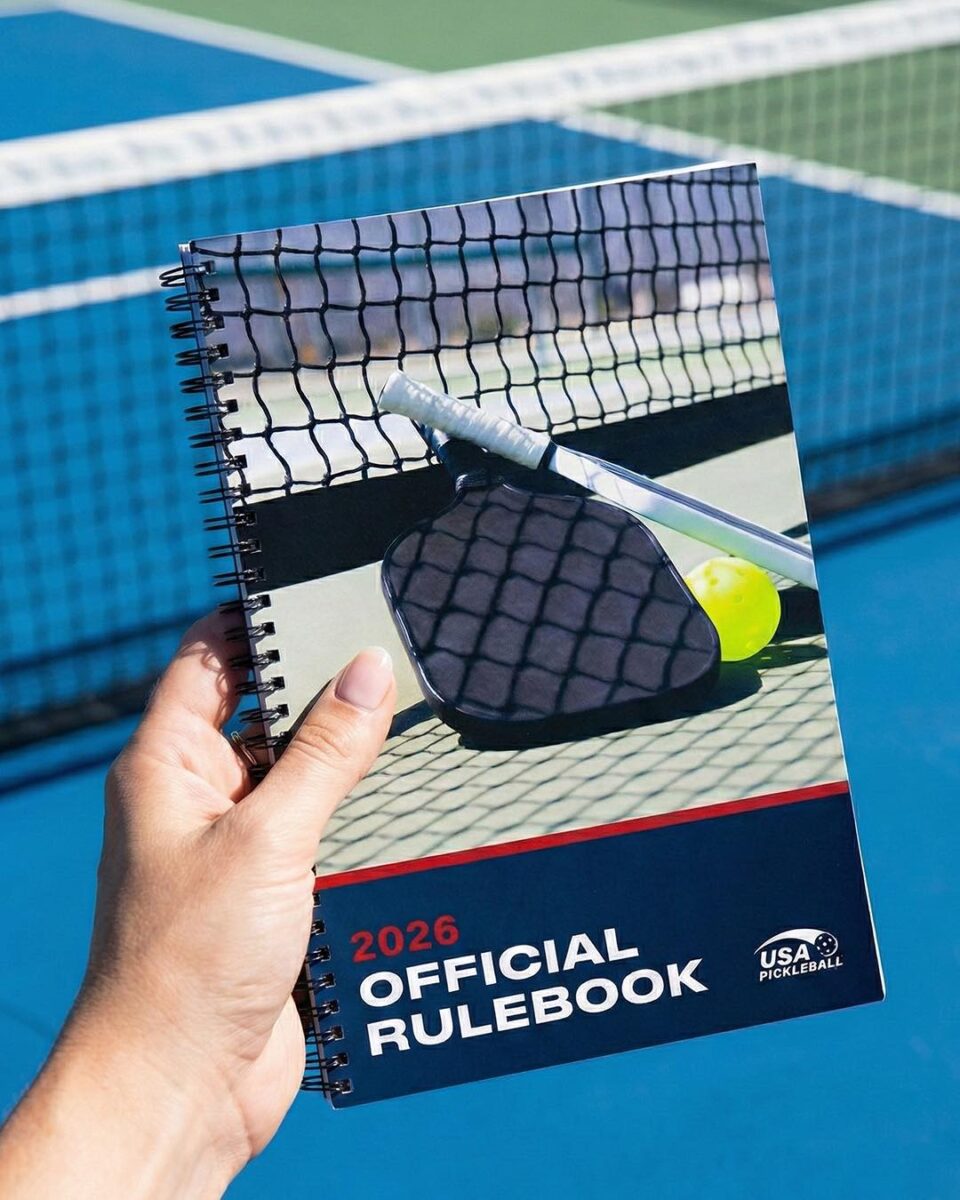
For those who simply want to understand what is new or different in the 2026 Rulebook, the following highlights summarize the more notable changes:
- Rally scoring remains in provisional status for 2026, after additional study by an independent third party. However, an important change was made: every rally now ends with a point. This means the receiving team can win the game on the final rally. For example, if the score is 13-14 and the serve goes into the net, the receiving team would win 15-13.
Provisional status means rally scoring will continue to be evaluated during 2026. After the season, a decision will be made to either retain it, modify it, or remove it from the Rulebook.
- If a player requests the Head Referee and the on-court referee acknowledges the request, but the player then rescinds it, the team will be assessed a regular time-out. If no regular time-outs remain, a technical foul (loss of a point) will be assessed.
- A similar provision applies to medical time-outs. If a player requests a medical time-out and medical staff are called, but the player rescinds the request before the staff arrive, the team will be assessed a regular time-out. If no regular time-outs remain, a technical foul will be assessed.
- Players requesting a time-out must now clearly indicate their intent to both the referee and their opponents. This may be done verbally (“Time-out”), by using the universal “T” hand signal, or both. The referee will acknowledge the time-out by moving to the center of the net and announcing: “Time-out, receivers 7-5-1, one minute,” in this example. This change is intended to prevent players from silently stopping play and walking off the court without communicating that they are requesting a time-out.
- The language in Rule 8.H has been updated to replace the word “doubt” with “conflict.” In situations where one partner calls a ball out and the other calls it in, the rule now reads: “When partners disagree on a line call, conflict exists, and the team’s call will be ‘in.’” This clarifies that disagreement between partners results in the ball being considered in.
- In cases where a player does not return the ball and cannot make an out call before the ball becomes dead (for example, the ball bounces up and immediately hits the player), an out call made promptly will still be valid, and the ball will be considered out.
- The rules for extra balls on the court have been tightened. It is now a fault if any extra balls, such as one in a pocket, are visible to an opponent or fall onto the court during a rally.